
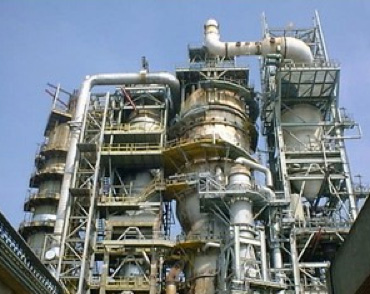
A modern fluid catalytic cracker employs a finely divided solid catalyst that has properties analogous to a liquid when it is agitated by air or oil vapours. In this arrangement a reactor and regenerator are located side by side. The oil feed is vaporized when it meets the hot catalyst at the feed-injection point, and the vapours flow upward through the riser reactor at high velocity, providing a fluidizing effect for the catalyst particles. The catalytic reaction occurs exclusively in the riser reactor. The catalyst then passes into the cyclone vessel, where it is separated from reactor hydrocarbon products. As the cracking reactions proceed, carbon is deposited on the catalyst particles. Since these deposits impair the reaction efficiency, the catalyst must be continuously withdrawn from the reaction system. Unit product vapours pass out of the top of the reactor through cyclone separators, but the catalyst is removed by centrifugal force and dropped back into the stripper section. In the stripping section, hydrocarbons are removed from the spent catalyst with steam, and the catalyst is transferred through the stripper standpipe to the regenerator vessel, where the carbon is burned with a current of air. The high temperature of the regeneration process heats the catalyst to the desired reaction temperature for recontacting fresh feed into the unit. In order to maintain activity, a small amount of fresh catalyst is added to the system from time to time, and a similar amount is withdrawn.
For more details: http://sciaeon.org/geology-and-geoscience/home
Submit your manuscript: http://sciaeon.org/submit-paper
Contact us: geology@sciaeonopenaccess.com

