
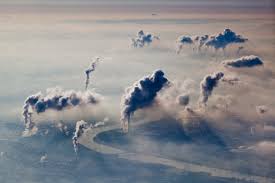
Air pollution, release into the atmosphere of various gases, finely divided solids, or finely dispersed liquid aerosols at rates that exceed the natural capacity of the environment to dissipate and dilute or absorb them. These substances may reach concentrations in the air that cause undesirable health, economic, or aesthetic effects. Clean, dry air consists primarily of nitrogen and oxygen-78 percent and 21 percent respectively, by volume. The remaining 1 percent is a mixture of other gases, mostly argon, along with trace amounts of carbon dioxide, methane, hydrogen, helium, and more. Water vapour is also a normal, though quite variable, component of the atmosphere, normally ranging from 0.01 to 4 percent by volume; under very humid conditions the moisture content of air may be as high as 5 percent. The gaseous air pollutants of primary concern in urban settings include sulfur dioxide, nitrogen dioxide, and carbon monoxide; these are emitted directly into the air from fossil fuels such as fuel oil, gasoline, and natural gas that are burned in power plants, automobiles, and other combustion sources. Ozone is also a gaseous pollutant; it forms in the atmosphere via complex chemical reactions occurring between nitrogen dioxide and various volatile organic compounds. Airborne suspensions of extremely small solid or liquid particles called particulates, especially those less than 10 micrometres in size, are significant air pollutants because of their very harmful effects on human health. They are emitted by various industrial processes, coal- or oil-burning power plants, residential heating systems, and automobiles. Lead fumes are particularly toxic and are an important pollutant of many diesel fuels.
For more details: http://sciaeon.org/geology-and-geoscience/home
Submit your manuscript: http://sciaeon.org/submit-paper
Contact us: geology@sciaeonopenaccess.com
 Journal of Geology and Geoscience